
19. What to do with other people's opinions | Rewrite your self-concept note 4/5
The Rewired for Good podcast | Episode 19 | 14 April 2026
Notes
How much of how you see yourself is influenced by other people's opinions? Why is it so hard to stop caring about what others think—and should we even try?
In this episode we unpack the powerful role that external opinions play in shaping your self-concept, especially in the humanitarian world where empathy and connection run deep.
You’ll discover:
why “just stop caring” advice doesn’t work,
how your brain is wired to seek approval,
and the hidden ways this impacts your decisions, confidence, and energy.
Most importantly, you’ll learn:
how to find balance between caring too much and not enough,
a practical, grounded roadmap to handle external feedback without spiraling and in alignment with your values.
If, like most aid workers, you’ve ever overanalyzed a comment, held yourself back, or felt shaken by what others think, this episode will give you clarity, perspective, and tools to move forward with more confidence and self-trust.
>> Listen to previous episodes of the "Rewriting your self-concept note" series:
- Episode 16: Identity in Rubble (1/5)
- Episode 17: Map out your current identity (2/5)
- Episode 18: Identity paradigm shifts (3/5)
Transcript
You guys know the fable of the couple with the donkey? There's a couple walking next to a donkey and people go “Wow! those people are idiots! Why do they have a donkey and then they don't ride it? What a waste!”
So then the wife gets on the donkey and the man walks next to them and people go “Well, that man does not know who the boss of the house is, letting his wife be comfortable while he does all the walking.”
So then he gets on the donkey, she gets down and she walks next to them. And then people go “Oh, that poor woman! Her husband doesn't care about her wellbeing at all. What a bad husband.
And then they both get on the donkey and people go “Ah, that poor donkey, two people on him. That's just animal cruelty!”
You cannot escape people's opinions, my friend. They tend to come out before you've even had time to form your own. That's what we're talking about in today's episode and how to handle it without losing your mind.
———
Dear friend, how are you doing? The more the world gets set on fire by our psychopathic, bloodthirsty billionaire leaders, the more critical it is to keep looking for that truth inside of ourselves and to find strength and clarity within. So I salute you for being here. If you're new, so glad you joined us. It's not easy to take the time to listen to this kind of stuff, to take steps, to look inward and to do the confronting work that we do here so that we are better equipped to handle the requirements of humanitarian life and to feel in control throughout. So thank you, thank you. I really am unspeakably grateful for the privilege of being able to record this for you.
This is the fourth episode of the Rewrite Your Self-Concept Note series or the Identity series. And in this episode, now that we have explored the power that a strong identity can have when you're going through tough times, now that we have mapped out your current self-concept and the belief systems about yourself. And now that you have looked at a few perspective considerations or paradigm shifts to start shifting things a little bit on how you see yourself, we are now going to take a close look at the role that people's opinions can play in your self-concept definition.
If there is something that I know, it's that we all struggle with this. It's really universal. Every single aid worker I've ever had the privilege to coach in my private practice over the past five years has been, is, will be suffering at some point from what other people think of them. Everyone. Yes. Even the top leaders, even the most seemingly calm and confident people. Wouldn't it be lovely if we could just learn to turn that off, right? Find the stop-caring button and boom.
And I feel like a lot of the self-care, self-development advice out there is precisely centered around that notion, right? “Three steps to stop giving an F”. “Let them think whatever they want”. “You do you”. “The art of not giving a crap”. The slogans are many, and thanks, that sounds great. But I have found that you can't just switch it off.
I've tried to not care. I have really, really tried for years. I have failed miserably. Just months ago, I was working with a team that I felt didn't have the right opinion and it was eating me alive day and night. So I have been to hell and back on this for you.
And the approach that I bring to you today is subtle. It is nuanced. The aid workers that seek coaching through my practice are extremely thoughtful human beings. And it has never, would never work to tell them to stop caring about other people's opinions. It's in their DNA. It's what makes them beautiful.
Caring about what other people think and feel about the impact of your behavior and who you are and your decisions and your life choices is partly what makes you so special, especially in this colonial, capitalistic, world of oppression that we live in. We need more of that beautiful quality, not less. So the last thing I want to do is gaslight anyone into thinking that other people's opinions don't matter and that you need to learn to stop caring so much.
I want to invite you to do this instead: Embrace that you're going to care for the rest of your life about what other people think of you. Just learn to do it better. I'm going to walk you through how that works. And hopefully by the end of this episode, you'll feel a lot more clear and a lot more empowered when other people's opinions shake you up.
First, let me ask you this: On any given day, how much time do you spend thinking about what other people think of you or your choices.
Take a minute to think about that. For me, it was easily over 50% each of my days. What she said, how he reacted, opinions about me, my choices, my intelligence, my looks, my past, my present, my future, the size of my nose, the hole in my sweater, that little smirk during the meeting, the silence after the text message. I'm overanalyzing constantly and I know one way or another you are too.
And here's another question: How many aspects of your life, professionally or personally, are the way they are simply because you want someone else to admire or like you? Your job, the way you dress, the music you listen to, what you say, what you don't say, the tech or the books or the car you own, what you repost on social media, all of it, how much of it is informed by your desire to be liked or by your desire to fit in.
And finally: how many things are you doing or not doing simply to avoid other people's criticism? This can be about how often you call home or how frequently you keep your mouth shut in meetings. Maybe you broke up with someone because one of your parents wasn't a fan of the relationship. Maybe you hide something from your boss. These examples are all taken from coaching aid workers.
And as mild or harmless as these examples may sound, they cause true suffering. I see it with my own eyes and it causes true identity struggles and rifts. And not to present us like, you know, a special bunch here, obviously, right? Because artists and teachers and stay-at-home moms and teenagers, everyone suffers from this. But I do want to say that I think that this affects aid workers in many specific ways.
Because humanitarians are, by definition, people who serve others, people who care about others' well-being, people who dedicate their lives to making other people's lives better, often at their own expense. So we are particularly good at empathizing, at staying connected to the rest of the world's heartbeat and responding to it. I think also very practically since 2020, when our work shifted a lot to virtual meetings and webinars and a lot of colleagues or stakeholders maybe don't turn their cameras on, it's becoming very hard to read people and we can feel very visually impaired in our social interactions.
And sometimes also, on the contrary, when people have their camera on, but they're kind of multitasking and you're talking and for some reason they start smiling or you notice a loss of attention from their part, it can be very, very easy to spiral and make it mean something negative about you. These are all things that were brought to my coaching sessions.
Now, of course, people bring all kinds of issues to my coaching sessions related to external opinions, but overall they all have very strong impacts on their work, their health, their wellbeing. And I'm going to mention three of the biggest impacts that I see regularly from not managing other people's opinions adequately or strategically, right?
The first impact that I see a lot when you don't manage other people's opinions properly is that it can lead you to play small because you don't dare to face criticism. hide, you stay in familiar comfort zones, you play safe. You make decisions based on what will preserve you because you're making decisions based on fear versus making decisions based on what will move you forward. What will be a reward for you? So it can lead you to lead a very risk-averse life.
It can mean ultimately that you don't allow yourself to live your life fully. You hold back. You never get to meet who you are. You don't say what you'd like to say. You don't wear what you'd like to wear. You don't do what you'd like to do. You don't dare to express what you want. You don't even dare to dream about what you want. It can have health repercussions, for example, right? I was living in a tented camp in the Sahel.
And we didn't have any freedom of movement in the town and we didn't have a gym in the compound. So the only way to move your body was literally to walk circles around the tents. And when you were looking at the aid workers that were making the decision to go for a walk after eating or before going to bed, it really looked like a prisoner's courtyard, right? Like you had people walking around in circles for half an hour. And I remember very distinctly that some aid workers were judging that negatively, and so were holding back from working out themselves because of the fear of other people's opinions.
So that's a very specific example, but it really is a striking one because it had, of course, health repercussions. When you spend four weeks not moving your body because you're afraid of what someone will think, it's not great, right? It can have massive repercussions on your work and your career. Maybe you don't dare to call someone out in a discussion when something doesn't feel quite right in terms of values.
Because what if you come off as too activisty or too emotional or too naive or uninformed? You self-silence. You don't say out loud what you think when you think that the emperor is naked. And that feeling that doesn't sit quite right within you, your values being under threat, you just shut that down and you live with it. Or maybe you don't raise your hand when there's a project that you'd like to contribute to because you don't want people to criticize you for being presumptuous or to think that you don't have what it takes to do a good job there. And of course it will have direct consequences on what opportunities you will have access to. The more you self-silence, the more you hold back for fear of criticism.
I want you to imagine a flame that could ignite itself and warm up a lot of people in a lot of rooms. But because that flame is afraid of being criticized, it remains very tiny. That's a huge loss. It's a huge loss for you. It's a huge loss for the world. It's a huge loss for the people who want to fall in love with your added value. It's a huge loss for the sector that we are in because our sector is in dire need of light. It's in dire need of bravery. And it's in dire need of new ways of thinking and of doing things. So that's the first thing: you play small and you don't shine as much as you could.
The second impact is that you make decisions based on what will get you the most external validation, approval, and admiration. You end up living your life on other people's terms, their desires, their values, their beliefs. So you end up being fueled by that external positive reaction. Your dopamine is released based on that external reward versus your own internal compass. So basically you find yourself being fired up by what fires someone else up.
And the danger with this one, contrary to the first one, is that it feels really good, right? The first one, when you were trying to avoid criticism, it does feel a little bit constraining. It does feel like you're shutting something down. But on this one, you get so much external reward that it actually feels really good. And you can end up convincing yourself that you are living your life correctly, quote unquote, because everyone approves of how you're doing it.
And the repercussions again on health and work can be many, right? For example, you can find yourself overworking, not taking leave. You're fueled by the positive comments of the boss who thanks you profusely for having no work-life boundaries and for answering emails at midnight. And that positive feedback feels so good. So you end up operating on that instead of getting the sleep that you need.
I have met hundreds of aid workers who work that way. In your love life, you may look for the partner that fits your community's requirements, right? Like age, geographic location, ethnic origin, versus being guided by someone who really, really lights your fire up. Basically you follow other people's compasses and they're not necessarily your own. And maybe you find yourself changing directions often, walking other people's paths instead of following your own.
And then finally, the third major impact that I see is I really want you to consider the energy, the time, and the inner power that gets allocated to that in ruminations and trying to change or to control those external opinions, in trying to handle the negative emotions that arise in us.
The aid workers that start working with me often come because they spend hours and hours on this and they don't want to do that anymore. It is such an energy leak. When you could allocate your energy to actually solving problems, to pursuing things that matter, that make a bigger impact in our world.
Someone disagrees with you in a meeting and you spend the rest of your day spinning, derailing the entire workday.
Obviously, I really hope it's not so extreme for you, but I do see this come up a lot. Aid workers coming to coaching sessions in tears because of words in an email that shattered their entire self-confidence and their capacity to do their work.
In 12 years working in the humanitarian sector, I have seen countless never-ending email chains where every person responds in order to control the opinions of the people in cc. You try to control what everybody thinks of the situation and the conflict. It never ends. It takes all of your energy, all of your time. It is not where we want to invest our time and our energy. It is not helpful.
Now, even if it's not helpful, it's very normal and explainable. Because from a very, very young age, noticing, understanding, anticipating, and even controlling people's reactions to us is how we survive from the very first breath that we take.
You learn very quickly that if you cry a certain way, you will get fed by your mom. You notice very quickly that if you act in this cute way, your mistakes will be forgiven more easily. You learn that if you throw a fit, you might get what you want or not, and you adjust.
You learn that if you make these kinds of jokes, this group at school will like you; that if you dress a certain way, that other group at school will treat you the way you want them to treat you. Later in the workplace, you learn that if you please your colleagues, life is a thousand times easier. So that's it again. We are fine-tuning our ability to get that feedback from other people's opinions so our life can be easier.
Of course we want to be appreciated by others and avoid their criticism. Of course. And before too long, your entire self-concept, the entire definition of who you are and how you behave, is defined by that, by other people's opinions.
And you know what? There's no point in trying to fight it. It's biology. A big part of the chemistry in our bodies is designed for that. Natural selection has built a human brain that relies heavily on the judgment of others for decision-making.
And it's not the case for every species, right? For example, reptiles are very independent. Their brains function very differently from ours because it's a species that can pretty much survive on its own, except for the reproduction part. But us humans, we cannot survive on our own. So we have a very sophisticated set of neurotransmitters that often get triggered based on other people's feedback and reactions, right?
You'll have heard of serotonin, which is all about your status, your power, your confidence, your place in the family group, in the school group, in the work group. Serotonin makes you feel like a million dollars when you can see that people respond well to you, respect you, follow you, look up to you, and then you can influence them. How cool is that?
And then you get, of course, bad feeling notifications thanks to your dear friend cortisol. Cortisol allows you to stay alert and to catch other people's signs of disapproval. Because it is so much harder to survive when you don't have other people's approval. So you want to track every smirk, every eyebrow movement, every sigh, every sign of impatience, the condescending tones, you name it. Cortisol is there for you to alert you.
And then there's oxytocin. Oxytocin's entire job is to make sure that you can connect and trust other people and also learn to feel safe in their presence. Again, that is based on the type of feedback that they give you.
I'm simplifying tremendously here, of course, but what I want you to move forward with is this really strong belief and understanding that caring about other people's opinions is not a problem. It's not immaturity. It's not a failure on your part. It's not a weakness. It's just exactly how it's supposed to work. It's normal. It's awesome. And it's essential.
What we do want to learn to do is to mitigate the negative impacts. So the solution is not to stop caring. The solution is to find the right balance between caring enough and not caring too much. And it's really not complicated. It's just not easy. You’ve got to learn two things, basically.
You’ve got to learn to care about what you think also, which is easier said than done, because in order to care about what you think, you have to know what you think. And a lot of people are not there yet. That's what we do in coaching.
And then the second step is to learn to care about what others think in a way that serves your life and your purpose instead of stopping you in your tracks and derailing you.
That's why having clarity on your own self-concept first is so critical. And that's what we're doing in these episodes on identity mapping and in the private coaching sessions with the humanitarians who hire me to be their coach. We build courage—courage that comes from within—self-sourced clarity, self-trust, self-leadership.
And we rewire the brain so that other people's opinions, for which there is no off button, become what strengthens you and builds you up instead of being something that threatens you, shrinks you, and takes you out of the game on a regular basis.
So the process to make that happen, as I was saying, is to first get clear on what you think, and second, to treat other people's opinions like simple data points.
Someone's opinion is just a data point. Whether it's praise or criticism, it's just a data point. It's not the truth. It's not God's words. It's not even an attack or a vote of confidence, not a provocation. It's just words that are a data point. It's a neutral piece of data. Sarah thinks this. Carlos said that. John wrote this.
And like any data point in a humanitarian response, it is worth absolutely nothing until it is properly processed.
The value of a data point resides in many, many other things: triangulation, assessing the accuracy, the reliability of the source, how long that data has been reported for, the conditions in which the information was collected and received, and so many other things.
And most importantly, does it align with what you already know to be true?
These are questions that define whether a piece of data is useful and worth keeping and examining in a humanitarian response. And it's the same with people's opinions about you, about your work, about your life, about your choices.
You're going to want to assess what the opinion tells you. How was it collected? Who did it come from? Is it a reliable source based on criteria of trust and expertise? Is it aligned with your values and what you know to be true and the life that you want to live?
That's it.
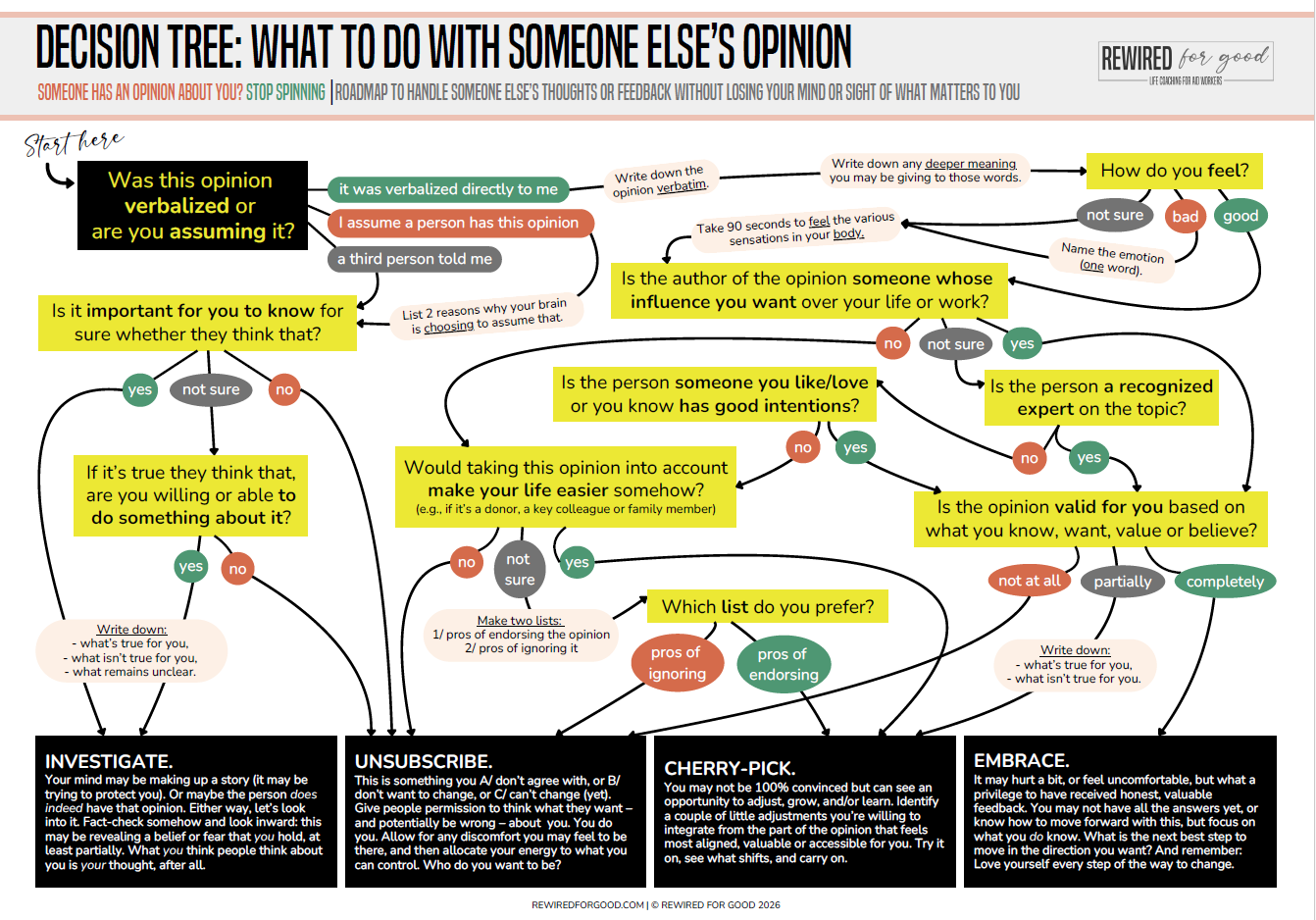
So to help guide you in treating other people's opinions like data points, I've created a decision tree. You can go to rewardforgood.com/podcast and download it there. You can keep it on your phone. You can print it out. It's super handy for any emergency freak-outs. And it's gotten me out of many mental and emotional issues quite a few times.
So go download it. The link is in the show notes. And in just five minutes, the decision tree walks you through several clarifying questions that will really help you connect with your own truth without missing out on the teachings, the learning opportunities that those external opinions can add to your self-concept and also add to your life in general.
In a nutshell, the decision tree walks you through questions like: why do you care? Why does it hurt? How does it hurt? The level of influence you want to give the author of the opinion. What is there to learn? Is there something to learn? Whether you're willing to do something about the opinion. Does it align with your beliefs?
And just by asking these questions, you'll be left with a lot of awareness and clarity because, as is often the case with coaching, most of the value of the process comes from dropping the questions in your brain.
Even if you don't have the answers immediately, you’ve got to trust that the answers will come. You’ve got to trust that the way forward will emerge. But that can only happen if you first ask yourself the necessary questions and ask them thoughtfully.
And once you drop those questions in your brain and you answer them to the best of your knowledge, you'll be left with four clear possible ways forward.
A: you need to go and investigate and fact-check further because clearly you don't have enough information.
B: you get to unsubscribe from that external opinion altogether because it's clearly poisoning you without really adding value to your life.
C: for personal growth or inner peace, you get to pick and choose one or two small changes that you can implement based on the opinion.
D: you can also fully embrace the opinion and get to work on fully changing whatever you feel needs changing.
But whatever you do, I invite you to go through this process from a place of self-appreciation. Remind yourself first how normal and beautiful it is that you care about what other people think about you. Love yourself more for it, not less.
Connect with your truth. Treat the external opinion as a data point. Process it like you would any data point. No more rumination, no more collapsing, no more paralysis, no more getting derailed for hours against your will.
Now here's a thought I borrowed from my coach, and I want to share it with you: If someone is going to be unhappy with who you are and how you live your life anyway, make sure that person isn't you.
Sometimes you're just going to have to agree to disagree. You cannot control other people's opinions. You cannot make them think you're doing it right. If they want to think that you're doing it wrong, someone, somewhere, somehow is going to think you should live your life differently, that you should be someone else.
That's okay.
Disappointing people doesn't have to be a bad thing. Just try not to disappoint yourself. Because fundamentally, you are the best expert of your life. Even when you feel lost, triggered, even when you feel like an imposter, no one can know the answers for your life better than you.
That's what I wanted to share with you today, my friends. Seek validation, avoid criticism, pay attention to feedback. I know it can feel excruciatingly painful sometimes, but it's all normal and it can be really valuable as long as you learn to hear yourself first and foremost, and as long as you learn to hear what others think in a way that powers you up.
Treat external opinions like data points, and if you learn to do that, the clarity and the freedom that you will gain will shine through every aspect of your existence: your career, your health, your relationships.
In the next episode, we will go through the final step for rewriting your self-concept notes, so you don't want to miss that one. We'll be bringing everything that we've covered until now together and we'll be redefining ourselves intentionally.
I want to leave you with these words from the magnificent Mexican artist Frida Kahlo. She wrote: "In the end, I believe that we don't need to do anything to be loved. We spend our lives trying to seem prettier, smarter, but I realized two things. Those who love us see us with their hearts and attribute qualities to us beyond those we really have. And those who don't want to love us will never be satisfied with all our efforts. Yes, I really believe that it is important to leave our imperfections alone; they are precious, to understand those who see us with the heart." End of quote.
And look, I don't know what people think about you. I sure hope that you think a lot of really good things about yourself. But I want to tell you that I know for a fact that if you are in this space, you're a pretty exceptional person as it is.
Because the fact that you are listening to this tells me you are willing to put things on the table, to be vulnerable, to examine facts, to take risks, to live fully, to do hard things, and to face difficult questions and difficult emotions in order to grow and make your life your own in this very chaotic world.
You are contributing to making our little humanitarian ecosystem stronger. And I am convinced that if we were all to learn to manage our brains and our emotions better, our world would become a lot brighter.
So thank you, thank you so much for being here.
Until next time, take excellent, excellent care of yourself.